Video
Oct 13, 2026
Podcast (Dutch Only): Who is accountable when AI does the audit work?
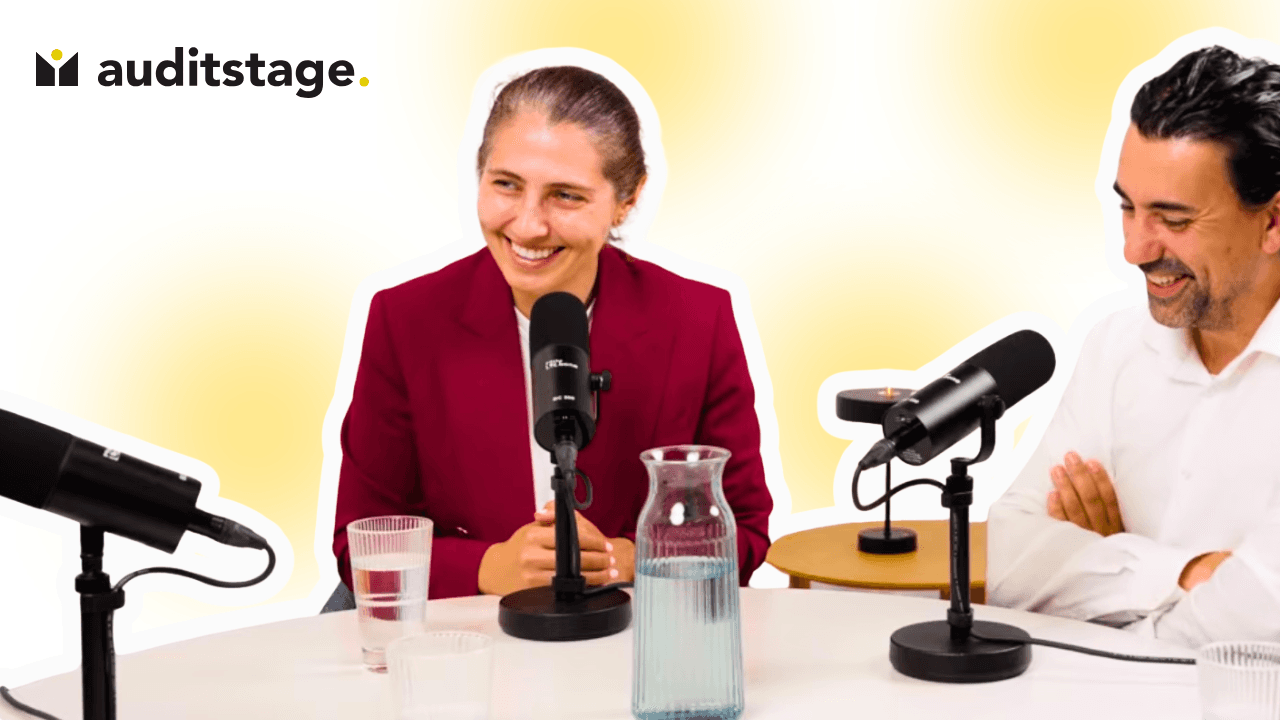
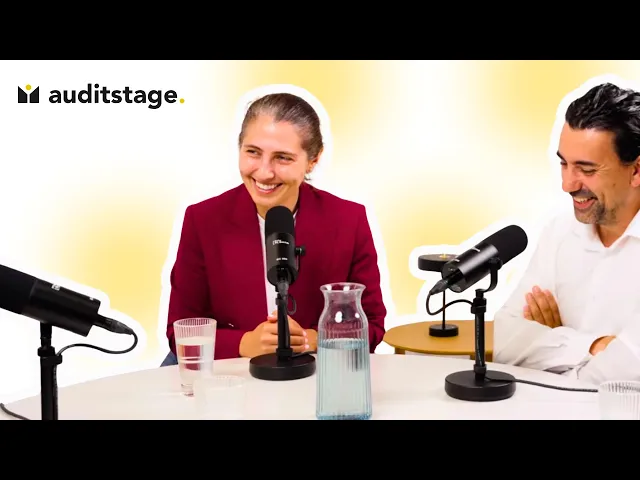
Our founder and CEO Natalia Khamraeva joined the second episode of "Kwestie van Vertrouwen" ("A Question of Trust"), the podcast of the Instituut van de Bedrijfsrevisoren (IBR-IRE). Host Sven Vonck spoke with her and Filip Simpelaere, audit partner at EY Belgium, about artificial intelligence in the audit profession. The episode is in Dutch and runs just over 50 minutes.
The conversation centres on a question every audit firm now faces: which parts of the work can software take over, and which will always depend on professional judgment? Below we pick out the themes that matter most to us, and explain how we approach them at Auditstage.
The auditor remains accountable
One chapter of the episode is devoted to a principle that sits at the heart of the profession: the auditor always remains ultimately responsible. Whatever role AI plays in preparing the work, an audit opinion is signed by a person, and that person must be able to stand behind every conclusion in the file.
This has a direct consequence for how audit software should be designed. AI can gather information, draft analyses and propose conclusions. It cannot carry responsibility. A tool that blurs that line leaves the auditor exposed at exactly the moment it matters most.
Opening the black box
The discussion also addresses the black-box problem: how did the AI arrive at this result? For auditors this is more than a technical question. ISA 230 requires documentation that allows an experienced auditor, with no previous connection to the engagement, to understand the procedures performed, the evidence obtained and the conclusions reached. An answer whose origin cannot be traced does not meet that standard.
At Auditstage we treat traceability as a design requirement. AI output is labelled as context until an auditor adopts it as part of the work. Every suggestion needs the auditor's explicit confirmation before it enters the audit file. Accepted AI-assisted work is stored with a tamper-evident record of what was produced, who approved it and when.
From preparer to reviewer
The episode also looks at what changes for junior staff. Young auditors traditionally learned the profession by preparing the file: reconciling balances, tying out figures and drafting working papers. As AI takes over more of that preparation, they start reviewing much earlier in their careers.
That shift raises a real question for audit firms. How do people develop professional judgment when they spend less time on the work that used to build it? In our view, the answer lies with the firms themselves, through deliberate coaching and structured review. Software can support this by keeping the review step meaningful. When every AI suggestion remains a proposal until someone confirms it, reviewing stays an active task.
Judgment in the grey zone
Audit work does not always come down to clear rules. The conversation turns to the move from rules-based to principles-based work, and to the auditor's role in situations where the rules give no clear answer. Those grey zones are where interpretation and professional choices matter most, and where human judgment remains essential.
Several wider questions follow. Should regulation adapt to AI? Does AI make the audit better, or only faster? What does a sound AI strategy look like for an audit firm? The guests also discuss the geopolitical context, including data centres and the position of American technology providers. That question matters to us: Auditstage hosts its data in the European Union and runs its AI on European models.
The episode closes on a dilemma many firms will recognise. Within one firm, people adopt new technology at very different speeds, and the risk of trusting AI blindly sits alongside the risk of ignoring it altogether.
Listen to the episode
The full episode (in Dutch) is available on YouTube, Spotify and Apple Podcasts.
Our thanks to the IBR for the invitation, and to Sven Vonck and Filip Simpelaere for the conversation. To see how Auditstage approaches these questions in practice, book a demo.
Finally, software that thinks like an auditor.
We're working closely with a select group of audit firms to refine and perfect the platform. If you want early access, a direct line to the founders, and the chance to shape a tool built around your workflow, now is the time.
Priority Support
White glove onboarding
Founder access